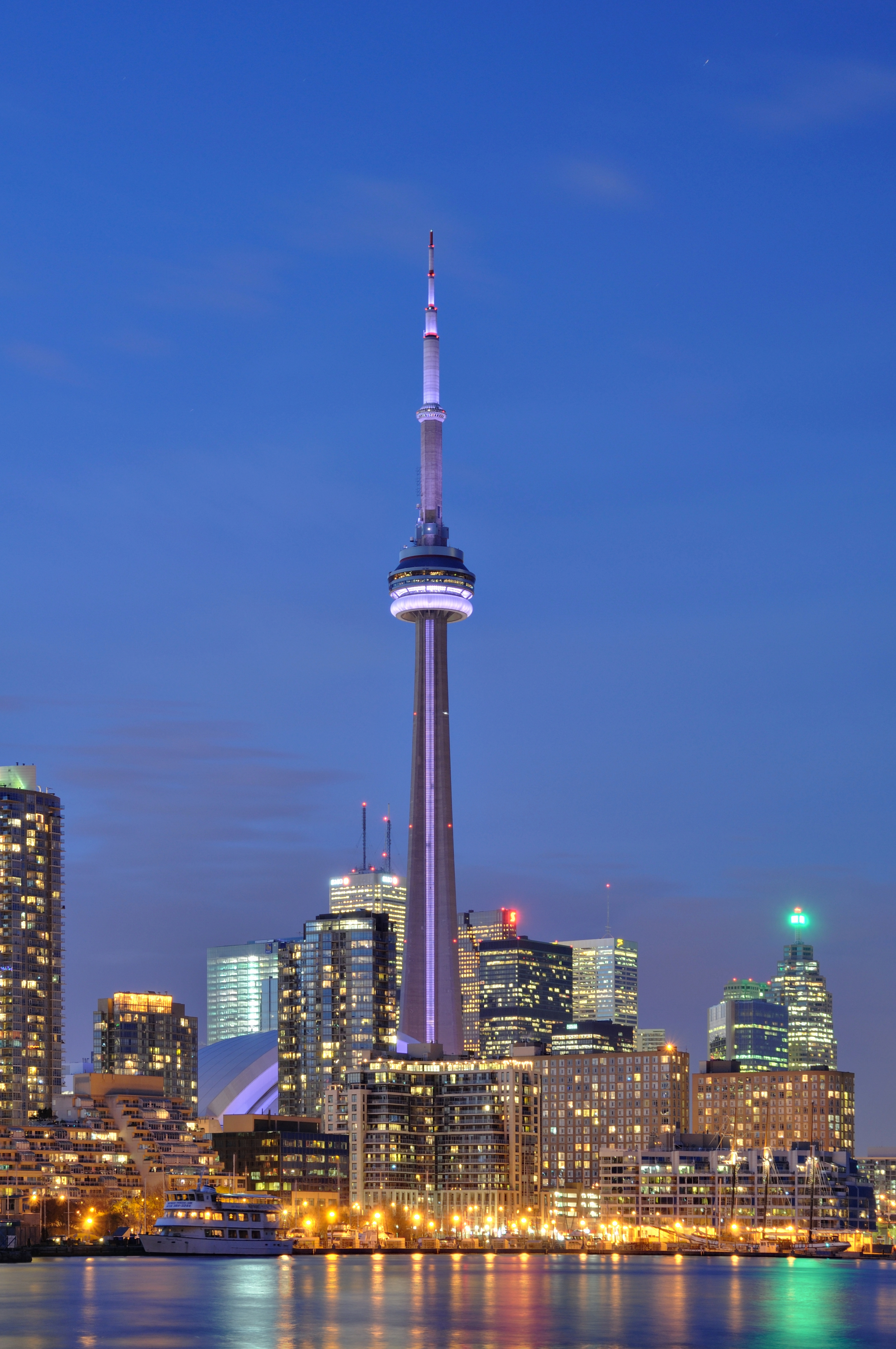
Why Toronto Built the Tower
By the late 1960s and early 1970s, downtown Toronto's expanding cluster of office towers interfered with television and radio transmission. Broadcasters and planners needed a structure tall enough to clear the new skyline and provide reliable regional coverage across southern Ontario.
Canadian National Railways sponsored the project as both infrastructure and national showcase. The resulting brief was unusually hybrid: the building had to function as a serious communications mast while also projecting confidence in metropolitan growth, engineering capability and modern Canadian identity.
The tower was not conceived as a monument first and a utility second. Its symbolic power emerged from a highly practical broadcasting and telecommunications requirement.
- Primary driver: restore clean transmission above a rising central-business-district skyline
- Secondary goal: create a public observation destination and tourism magnet
- Civic effect: give Toronto a singular vertical marker legible across the wider region
Concrete Shaft and Slipform Construction
The core construction method was continuous slipforming, a technique that allows concrete to be poured in a steady upward process while formwork climbs incrementally. This approach suited the tower's height because it reduced joint complexity and maintained a consistent structural shell.
Workers operated around the clock as the shaft rose. The triangular plan with curved sides created a stable, efficient geometry: wide enough at the base to resist overturning, yet slender enough aloft to minimize weight and wind area.
Slipforming rewards disciplined sequencing. Concrete mix control, climbing rates and weather monitoring are all critical when the structure cannot simply pause at every floor plate.
Wind, Vibration and Structural Stability
Extreme height makes lateral behavior as important as gravity loads. Engineers shaped the tower to reduce vortex shedding and used mass, taper and stiffness to limit perceptible movement for occupants while preserving antenna performance.
The broad lower shaft acts as the tower's main stabilizing body, while upper observation levels and the steel mast are integrated into the total wind-response strategy. The resulting system does move in strong conditions, but within carefully engineered tolerances expected for very tall towers.
- Tapered profile lowers wind pressure compared with a blunt constant-width shaft
- Reinforced concrete provides stiffness and damping advantages at the main shaft
- Observation areas must balance structural efficiency with comfort and public confidence
These design questions place the CN Tower within the broader history of megatall structures, where public experience depends as much on controlled flexibility as on apparent monumentality.
Pod Design, Elevators and Public Program
The observation pod is the tower's architectural hinge between utility and destination. It houses viewing floors, hospitality space and circulation systems that transform a telecommunications structure into a building people can occupy and remember.
High-speed elevators were integral to the concept, not a secondary amenity. Vertical transport had to move large visitor volumes quickly enough that the summit felt accessible rather than remote, especially in an era when tower tourism was becoming a global attraction.
In towers of this type, elevators are part of the architecture. They compress the city's horizontal scale into a short mechanical journey from street to panoramic altitude.
- Observation program broadens revenue beyond broadcasting
- Restaurant and event uses reinforce all-season visitation
- Glass-floor and edge experiences extend the tower from viewpoint to spectacle
From Broadcast Utility to Enduring Icon
Digital communications have changed the tower's technical context, yet the CN Tower remains instructive because it solved a concrete broadcasting problem with a form capable of long civic afterlife. That durability is part of the engineering achievement.
Few structures so clearly demonstrate how infrastructure can become cultural shorthand. The tower still anchors orientation, tourism marketing and skyline photography while preserving its identity as a piece of high-performance structural and transmission engineering.