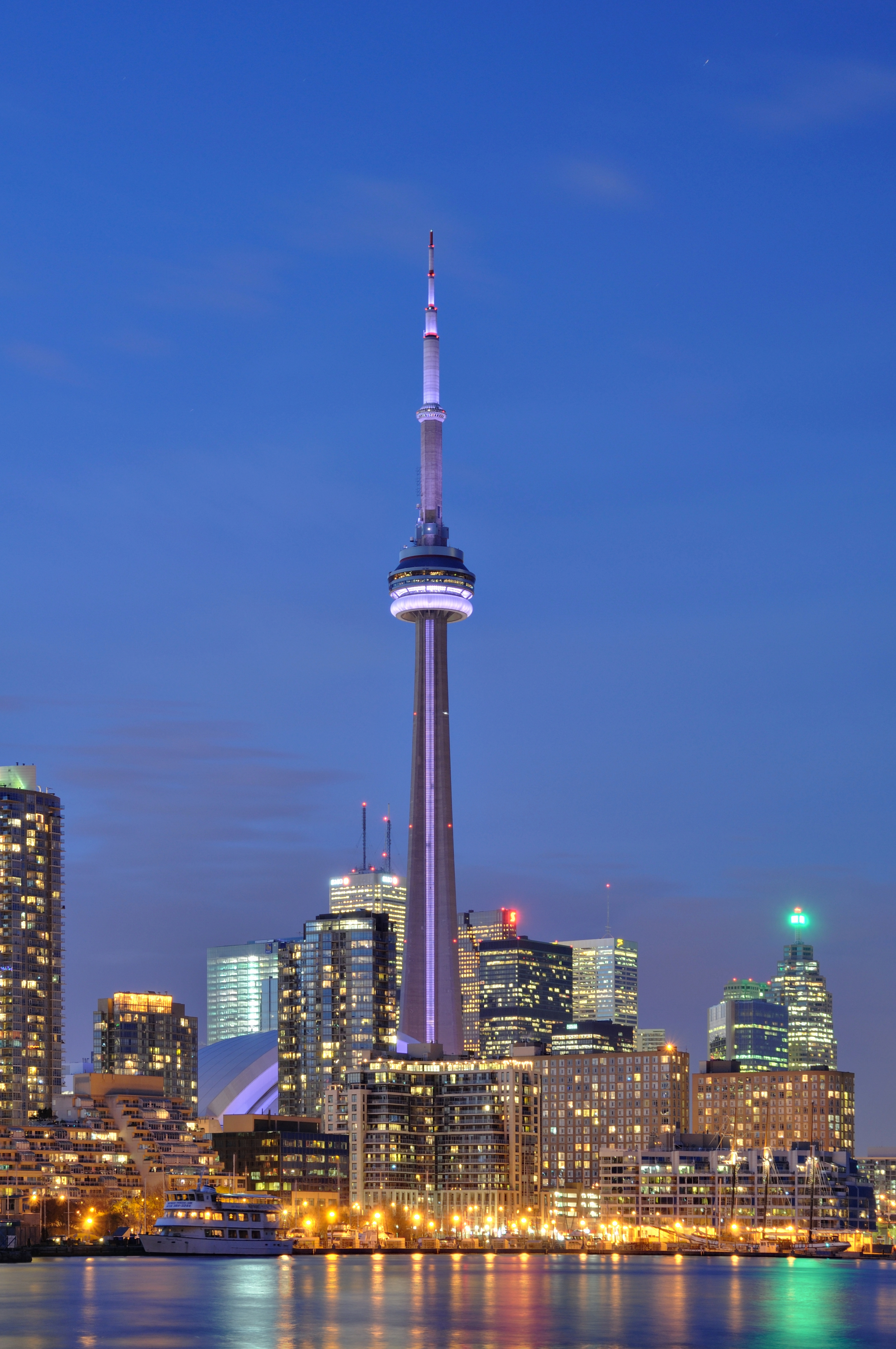
Financial District and the Corporate Core
The financial district remains the historic center of Toronto's corporate skyline, with banking headquarters, law firms and Class A office towers concentrated around Bay, King and Wellington streets. Underground PATH connections, transit access and dense parcel values reinforce its primacy.
This area supplies much of the skyline's commercial mass, yet it is only one part of downtown. Its polished towers are complemented by civic, cultural and residential districts that broaden what the center city means.
Downtown Toronto is strongest when read as a network of adjacent specializations rather than as a monolithic high-rise zone.
Entertainment District and the Tower Precinct
West and south of the financial core, the entertainment district gathers theaters, media uses, hotels, sports venues and restaurant traffic around some of the city's most visible blocks. The CN Tower sits within this broader tourism-and-events geography near Rogers Centre and the rail corridor.
That setting matters because the tower is not detached from urban life. Visitors can approach it through active streets, stadium crowds and mixed-use development, experiencing it as part of downtown choreography rather than as a remote scenic object.
- Sports and event venues generate constant foot traffic
- Hotels and restaurants support tower-oriented tourism
- Rail lands redevelopment created new residential and mixed-use frontage nearby
Civic and Institutional Downtown
Areas around City Hall, the university precinct and major hospitals add a civic dimension to downtown that the skyline image often understates. These districts concentrate administration, higher education, public services and protest culture within the central area.
They also diversify the downtown user base. Students, office workers, residents, tourists and patients inhabit overlapping but distinct rhythms, making Toronto's core feel more multipurpose than many purely commercial downtowns.
A skyline can imply elite exclusivity; district-level reading reveals the everyday institutions that keep the center city socially mixed and operationally dense.
Residential Downtown and Vertical Neighborhoods
Condominium growth transformed former rail-adjacent lands and underused parcels into large residential districts. Places such as CityPlace and nearby tower clusters introduced schools, grocery needs, parks and everyday family routines into what had once been primarily employment or infrastructure terrain.
This shift changed the social meaning of height. Towers are not only symbols in the distance; they are homes, corridors of local commerce and pieces of neighborhood identity for a substantial permanent population.
- Residential growth extends downtown activity beyond office hours
- Podium retail and schools support everyday neighborhood life
- Park provision and transit access are now central planning questions
Walking the Core as a Way to Understand the City
One of downtown Toronto's advantages is that several distinct districts can be read in a single walk: finance to entertainment, civic center to waterfront, heritage streets to contemporary towers. The CN Tower appears and disappears throughout that sequence, acting as a repeated orientation device.
For visitors, that legibility is powerful. For planners, it is evidence that the city center's success lies not in any single tower or precinct, but in the adjacency of many complementary urban roles.